Thursday, June 14, 2012

Fermentation In The News: Sandor Katz On NPR

Sandor Katz, grand-daddy of the modern fermentation revival, author of Wild Fermentation, and one of my inspirations in my fermentation work and in my life, was on NPR yesterday talking about fermentation and his new book, The Art of Fermentation. The segment was entitled: 'Fermentation': When Food Goes Bad But Stays Good.

Hah!

I am glad that fermentation is getting mainstream airtime. The more people hear about it, the better for everyone.

Sandor's book, The Art of Fermentation, is a masterwork on the subject of fermentation: how to do it, why, history, philosophy, biochemistry—everything. It is ideal for folks who want to know as much as possible about fermentation and fermented foods, who are already actively fermenting things, or who are not afraid of jumping in with both feet.

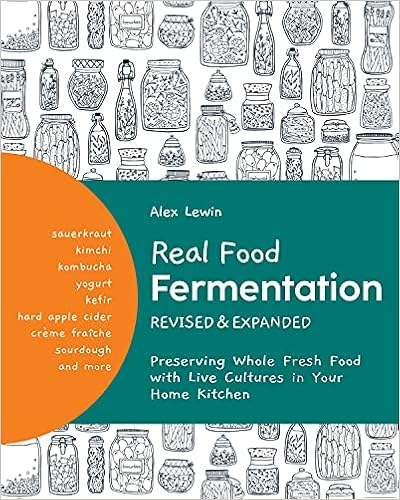
My book, Real Food Fermentation, is better suited to folks who want to get started with simple fermenting recipes in their home kitchens, who prefer something closer to a more typical cookbook format, and who want a beautiful book with pictures that make the food come alive. I will add that the first 60 pages of my book aren't recipes—they are a discussion of food preserving in general, "real food", sustainability, health, how to choose ingredients, what kitchen equipment to get, and other topics.

Buy one, buy the other, or buy them both!

(If you are buying my book, please consider buying it this coming Monday, June 18, to spike its popularity on Amazon!)

(And in either case, please consider buying from a local independent bookstore rather than online. If we stop buying books from local bookstores, they will all go out of business, and we will be sorry.)

Wednesday, June 13, 2012

First Review Of Real Food Fermentation

Someone I don't know posted this extraordinarily accurate and thorough (and positive!) review of my book on Amazon.com. He understood exactly what I was trying to do, and why, and how, and all of the decisions I made.

If you would like to know more about my book, I strongly recommend that you click here to read the review. He says it all better than I could.

We all feel misunderstood sometimes. Today I felt really understood. Thank you, Brandon Curtis, if you are reading this!

PS:

If you choose to buy my book, please buy it at your local independent bookstore (which you can find on this awesome list that my friend Paula sent me), or else buy it from Amazon.com on June 18 (or any other day).

Tuesday, June 5, 2012

I Wrote A Book: Real Food Fermentation

Dear Readers,
I have written a book called Real Food Fermentation. It will be on sale any day now. I have been working on it for over a year, and I'm very excited for its launch! If you don't mind, please wait until June 18 to buy it. If enough people buy it from Amazon on the same day, it will show up on their best-sellers lists, and more people will see it.
Here's why you should buy it:
It is a photo-illustrated, step by step cookbook that shows you how to make fermented foods. The photos really make the recipes come alive (pun intended!). And they are beautiful photos; my photographer is an ace. There are other fermentation books out there, including some new ones, but to be honest, mine is the prettiest by far, and the step by step pictures make my recipes very easy to follow.
Here's when you should buy it:
Please wait until June 18 to buy my book. If everyone buys it on the same day, then my book will rise on Amazon's best-sellers lists, and more people will notice it and buy it.
I'll post a couple more times before then with more details about the book.
(If you want the book but you don't want to wait until June 18, or you think you'll forget about it in the meantime, then of course buy it now!)
Click here to see it on Amazon:


Tuesday, April 17, 2012

Inspired By A Friend: Meat Of Known Origin, Revisited

I've blogged lots about Meat Of Known Origin. For some time I was strict only eating Meat Of Known Origin. Then I found myself working in an office where meals were delivered every day. They weren't always MOKO, and they were often hard to resist. And I didn't resist.

Recently, I've watched my friend Mike become aware of the problems with the modern food system. His horror and astonishment at how we make our food reminded me of my reaction when I started paying attention—and reminded me that nothing has changed. All the reasons I had for avoiding factory meat are still valid.

Mike recently made the following declaration on my Facebook page:

I'm turning selective carnivore here on out; I will strive to know where my meat came from and how old it was when it was slaughtered (no more growth hormones thank you very much) and what it was fed while it was alive and hopefully happy running around in a large field with just the right number of friends. I may starve…

Pretty inspiring.

Well, that was all I needed. I'm back on the wagon. "What he said."

To be specific: chicken, pork, and beef. Chicken and pork must be from a known small farm with known practices. Co-ops (like Niman Ranch) will be evaluated on a case-by-case basis. Beef should be from a known farm, but if it's not it must be grass-fed (ideally 100%). If I'm at someone's house, I may or may not eat to be polite. (Jonathan Saffran Foer discusses this specific conundrum quite thoughtfully in Eating Animals.)

The problems with other land animals are much less dire than the problems with chickens, pigs, and cows.

The problems with seafood are a whole other story. If we can avoid farmed ocean fish and eat low on the ocean food chain most of the time, that's a good start. The Monterey Bay Aquarium has some good reference material on their website, and Taras Grescoe wrote a great book on the subject called Bottomfeeder: How to Eat Ethically in a World of Vanishing Seafood.

Does anyone have stories about their reactions when they learned about modern meat production?
Thursday, February 23, 2012

Harvard Food Law Society Raw Milk Debate


The Harvard Food Law Society raw milk debate: Sally Fallon Morell (President, Weston A. Price Foundation) and David Gumpert (Author, The Raw Milk Revolution) representing the "pro-raw milk" side, vs. Fred Pritzker (Pritzker & Olson Law Firm) and Dr. Heidi Kassenborg
(Director, Dairy & Food Inspection Division, Minnesota Dept. of Agriculture) on the "anti-raw milk" team.

How safe is raw milk, compared to other foods like cantaloupe, spinach, ground beef, etc.? Should we have the right to choose what we eat based on what we believe?

The pace of the debate may be a little slow for folks new to the issues, but it is an interesting point of contact between the two sides, to be sure.

We can buy tobacco without having to drive to a farm, we can buy alcohol without driving to a distillery, and we can buy both without having to sign waivers. Surely these are more dangerous than raw milk--and yet raw milk is more difficult to buy in most of the US, and not available nearly as widely as cigarettes and alcohol.

How many deaths can truly be ascribed to raw milk, vs. alcohol and tobacco? Is it possible that raw milk regulations, and prohibitions in general, are motivated by something other than concern for public safety?

Fred Pritzker even said it--the regulatory status of raw milk is ultimately a matter of politics, not of science. The more we demand access to raw milk, the more we tell our politicians and regulators that it's important to us, and the more willing we are to defy ridiculous ordinances, the better our prospects for reasonable food laws.