Sunday, May 10, 2015

Beet Kvass: The Easiest Fermented Beverage

There are a lot of fermented beverages in the world.

Alcohol fermented beverages are very visible: some examples are wine, beer, hard cider, and mead. Historically, these beverages have served many roles. Alcohol has psychoactive properties, so since the beginning, these drinks have had roles in religious and spiritual ceremonies and practices. And alcohol is anti-microbial, so these drinks remain safe to drink even in places where drinking water is not. In the past, these drinks were common everyday beverages. Many of them had lower alcohol content than today's versions.

Because of the popularity of alcohol fermented beverages, it is easy to overlook the importance of sour fermented beverages. Sour dairy drinks like buttermilk, whey, kefir, and yogurt and yogurt-based drinks have been important dietarily and culturally for a long time. Kombucha has recently become a huge industry in United States. Other drinking vinegars and shrubs have recently become trendy in the realm of craft cocktails. And it is easy to forget that root BEER and ginger ALE were originally fermented beverages, too, before they became flavors of soda.

In my opinion, a great starting point for home beverage fermenting is beet kvass. It is very easy to make, it is tasty (at least I like it!), and it has great health benefits.

Here is my recipe for beet kvass.

Beet Kvass

(makes 2 quarts / 2 liters)


Ingredients


  • 2 or 3 medium-sized red beets, rough cut into 1/2-inch (1cm-2cm) cubes or equivalent. (If they're organic, no need to peel them.)
  • 1Tbsp (15g) high-quality salt (sea salt or Himalayan salt is best; kosher salt is okay too)
  • filtered water (no chlorine)
  • (optional) a few slices of ginger

Equipment

  • a 2-quart (2L) mason jar

Instructions

  • Add beets to the jar to fill it to about 1/3 full.
  • Add water to fill the jar to 1/2 full.
  • Add salt (and ginger if you are using it).
  • Put the lid on the jar tightly, and shake the jar until the salt is dissolved.
  • Open the jar, and add more water until the jar is nearly full, leaving 1 inch (2.5cm) of space at the top.
  • Close the jar, and let it sit for 4 days to a month or longer.
Every day for the first several days, feel the top of the lid, and if it is firm, "burp" the jar (unscrew the lid just enough to let some air escape, then tighten it again). 

You may start drinking the kvass any time you like, but it's best after at least 4 days, or longer if you are in a cooler environment.

Once you have started drinking it, it is best to keep the remaining kvass in the refrigerator--otherwise the exposure to air can encourage yeast to form on the surface, and your kvass can become slimy.

The beet pieces may be eaten along with the drink, or they may be used in a salad, juiced, or whatever.

You can experiment with shapes besides cubes if you like, but if you cut them too small, the kvass may become slimy.

Beet kvass may be consumed on its own, as a daily health drink. But it can also be used in soups, like borscht or gazpacho, or in sauces (keeping in mind that its health benefits are diminished if it's heated). It can even be used in mixed drinks like Bloody Marys and micheladas!

Monday, April 20, 2015

Basic Fermenting Recipes

I'm making this post for attendees at the hands-on the workshop I did at Pollinate Farm & Garden in Oakland, California on April 19.

But anyone else is welcome to read the post too. :-)

Please post in the "comments" section below if you have questions, or if you'd like to discuss other ways to eat these fermented foods (I've offered a couple, but I've only scratched the surface).

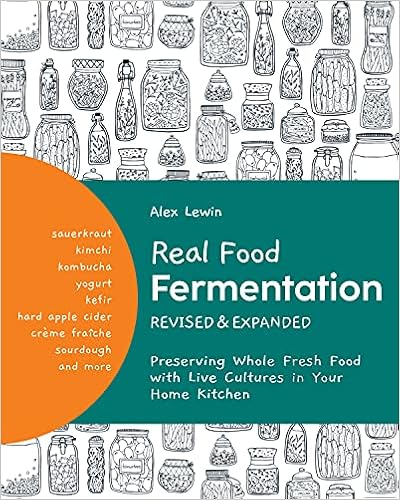
My book, Real Food Fermentation, has more information about fermented foods. Click here for information about how to get the book.

Basic Sauerkraut

Ingredients and Equipment

  • cabbage (round, green or red)
  • salt (1/3 ounce or 2 tsp. per pound of cabbage; or 20g per kg of cabbage)
  • large, sharp chef's knife
  • large cutting board
  • large mixing bowl
  • mason jars, preferably wide-mouthed (a bit more than 16 oz. capacity per pound of cabbage)
  • a digital kitchen scale (available from your favorite brick-and-mortar store, or online)
  • (optional) a thin, narrow-mouthed mason jar to stuff with

Instructions

  • chop cabbage, finely or coarsely
  • put cabbage and salt in mixing bowl
  • squeeze cabbage and salt vigorously with hands until liquid runs freely (this may take a few minutes)
  • put cabbage and liquid in mason jars, leaving an inch or two of "headroom", and close lids
  • leave to sit, not in sunlight, but somewhere you won't forget about it (kitchen counter?)
  • "burp" the jars every day for the first few days (if you don't do this, they may spill over and/or break the top!)
  • it's ready after 4 days or 4 months or somewhere in between, depending on how you like it

Eat it

  • on its own
  • on a sandwich
  • as a side dish with grilled meat
  • juice it!

Mixed/Fancy Kraut

Follow recipe for Basic Sauerkraut, but use a mixture of vegetables instead of just cabbage, slice or cut into shapes and sizes as you like, and/or add herbs and/or spices to taste. Caraway seeds are a classic seasoning; 1 tsp per pound of cabbage is a ballpark amount, although different caraway seeds have different potencies. Things like garlic, ginger, turmeric, horseradish, burdock, etc. can provide nice flavor and health benefits.

Beet Kvass

Ingredients and Equipment

    • a handful of beets (red or golden, number needed may vary with size)
    • 1 Tbsp salt
    • large, sharp chef's knife
    • large cutting board
    • half-gallon mason jar
    • (optional) vegetable peeler 

    Instructions

    • fill jar halfway with water
    • add salt
    • put lid on jar and shake until salt is dissolved
    • if the beets are not organic, peel them
    • cut beets into 1/2-inch cubes
    • put beets in mason jar, to fill about 1/4 or 1/3 of jar
    • fill jar nearly to top with water, leaving an inch or two, and close lid
    • beet greens, if there were any, can be fermented as "Mixed/Fancy Kraut" recipe above
    • wait a 4 days to 4 weeks, tasting the liquid periodically
    • once you like it, strain out the beets and store them separately
    • the liquid is "beet kvass"
    • the fermented beets may be slice and used in a salad, or juiced, or whatever

    Drink it

    Preserved Lemon (Citrus)

    Ingredients and Equipment

    • lemons, Meyer lemons, limes, or citrus of your choice, ideally from a garden rather than from a shop
    • salt (approximately 10% of weight of citrus)
    • knife & cutting board
    • mixing bowl
    • big mason jars
    • (optional) "pickling spice" mix from store (without preservatives; read the ingredients)

    Instructions

    • cut citrus into approximately 1/2 inch (1 cm) squares
    • squeeze citrus over mixing bowl; add the peel to the bowl as well
    • add salt and optional spices to bowl; mix
    • pack the mixture tightly into mason jars, leaving an inch or two of headroom, and close lids
    • let the lemons sit for months or years

    Eat it

    • anywhere you might use fresh lemon
    • in your potato salad (or tuna salad or chicken salad)
    • cook it with fish or roast chicken
    • add a shot of sweetener for a fermented lemonade

    More Things to Read


    Thursday, August 7, 2014

    One More Nail In The Coffin Of The Lowfat Diet

    Yesterday I heard a segment on the radio (KQED public radio in SF) in which investigative journalist Nina Teicholz spoke about her new book, The Big Fat Surprise: Why Butter, Meat and Cheese Belong in a Healthy Diet. Her book makes a scientific, "evidence-based" case for eating a diet high in saturated fats, and explains the rise and reign of the low-fat myth.

    She spoke well. The audio is available here and/or here. She is also speaking at the Commonwealth Club tonight.

    This is interesting to me for various reasons.

    First, I want to know what to eat to keep myself healthy. I've been eating a diet high in saturated fats for a while now, and it's nice to have further confirmation that this makes sense.

    Second, Sally Fallon Morell and the Weston A. Price Foundation have been on the record in favor of the high-saturated-fat diet for at least fifteen years, and for most of that time, they were disparaged and/or dismissed by the mainstream.

    The fact that the saturated fat idea has become palatable to the liberal establishment (as represented by public radio and the Commonwealth Club) is heartening to me.

    Let's hope that they get curious and start examining the rest of the dietary dogma that has been force-fed to an easily led public.

    Friday, July 11, 2014

    Upcoming Events: Farm to Fermentation Festival, WAPF Massachusetts Conference, Boston Fermentation Festival

    I have three very exciting speaking engagements coming up this summer and fall.


    First, on August 24, is the Farm to Fermentation Festival, an annual event in Santa Rosa, California, 60 miles north of San Francisco. I believe it was at this festival a few years ago that Michael Pollan and Sandor Katz started talking about working together, which laid the groundwork for Pollan's book, "Cooked". Who knows what propitious meetings might occur this year?

    I'd encourage SF Bay Area folks interested in pickles, cheese, or beer to come to this event. (Doesn't that cover just about everyone?) I can't wait for the "Cheese and Beverage Pairing" talk, myself. The whole event will be fun and educational. Here's the lineup of speakers. If you use the special discount code "pickle", you can save $5 off admission.


    Next, on September 20, I will be speaking at the the Weston A. Price Foundation Massachusetts regional conference in Southbridge, 60 miles west of Boston. For anyone who has been to a WAPF conference, you know how awesome the conferences are. And for anyone who hasn't, you have something great to look forward to. And the food is the best conference food you will ever find.


    Finally, on September 27 in Boston, I will be speaking at the Boston Fermentation Festival. Last year's Festival was a real coming-together of the Boston fermenting community, bringing in more than 1000 people over the course of the day. This year should be even more popular and awesome. Sandor Katz is headlining. I'm thrilled to be a part of it!

    Please post in the comments section if you have any questions.

    Sunday, June 8, 2014

    Boston Fermented Dinner And Drink Pairing Pop-Up, Monday June 16


    Boston-area fermentos Geoffrey Lukas (of Sofra) and Jeremy Ogusky (of Boston Ferments and Ogusky Ceramics) have teamed up to offer a Fermented Dinner and Drink Pairing, at City Girl Café in Inman Square on Monday June 16. Details are here and here. It will be fabulous, and some of the proceeds will go to support the Boston Fermentation Festival in September. And all attendees will get a commemorative hand-made ceramic cup!

    Again, details here and here.

    Sign up now before all the tickets are gone!

    And if you're not around Boston and/or you can't make it, please draw inspiration from the menu, and think about what kind of fermented events might work where you live...