Showing posts with label sauerkraut. Show all posts

Monday, April 20, 2020

Covid Cabbage

…also known as sauerkraut.

One of the simplest and most universal ferments.

All of a sudden, buying vegetables is not a sure thing. So gather ye cabbages while ye may…and ferment them!

To topic of sauerkraut has been beaten to death, but I can add some advice on jar selection.

Here goes:

    Saturday, March 4, 2017

    Today's Fermentation Demo: Program and Notes


    I'm doing a fermentation demo and talk today at the Kitchen at Boston Public Market!

    If the technology gods are willing, it will be live-streamed on the Real Food Fermentation Facebook page.

    I'll be demoing the following recipes, and I'll have samples available:

    - Sauerkraut
    - Beet Kvass
    - Tepache

    And if there's time, I'll also demo:

    - Preserved Lemons

    I've blogged about Sauerkraut, Beet Kvass, and Preserved Lemons before, here.

    Tepache is new to this blog, and is a sneak-preview of a recipe from Ferment Your Drinks, my upcoming new book with co-author Raquel Guajardo. When it's officially available, you'll hear lots more about it!

    Tepache is a pineapple wine from Mexico. It has low alcohol--maybe a couple of percent--significantly less than beer. This is partly because of its short ferment time (typically less than a week), and partly because it's a wild ferment, so in addition to the yeasts that convert sugar to alcohol, it picks up some bacteria that convert sugar and alcohol to acids.

    This means that it is sour. It's great on its own, or as an ingredient in a cocktail of whatever sort.

    There are many other nice things about tepache, besides how delicious it is. One is that it allows you to use a portion of the pineapple (the skin) that you would normally just compost or toss. Another is that if you mess up the recipe and let it ferment for too long, you wind up with some nice pineapple vinegar. Hard to go wrong!

    Tepache

    Ingredients:

    - the outer husk and core of one pineapple (the part you can't eat) (I highly recommend this tool!)
    - one cup of sugar, ideally piloncillo/panela/jaggery/rapadura/raw sugar/brown sugar
    - mixed spices: "pickling spices" will do nicely; make sure they contain no preservatives
    - filtered water

    Equpiment:

    - 2-quart mason jar, with metal ring
    - unbleached basket-type coffee filter, or unbleached paper towel, or clean cloth towel

    Procedure:

    In a 2-quart mason jar, dissolve the sugar in a pint of warm water (body temperature or a little cooler).

    Cut the pineapple husk and core into chunks roughly 1 inch on a side. Add it to the jar, along with the spices.

    Fill with (room temperature) water to 2 inches below the top.

    Place filter or towel over the top of the jar, and secure with ring.

    Wait 3 or 5 days, or until foamy and aromatic.

    Strain

    Drink chilled, or over ice!

    Variation:

    If you want more alcohol and fizz, try putting a tightly-sealing lid on once it starts foaming, then leave it for up to a week.

    Monday, April 20, 2015

    Basic Fermenting Recipes

    I'm making this post for attendees at the hands-on the workshop I did at Pollinate Farm & Garden in Oakland, California on April 19.

    But anyone else is welcome to read the post too. :-)

    Please post in the "comments" section below if you have questions, or if you'd like to discuss other ways to eat these fermented foods (I've offered a couple, but I've only scratched the surface).

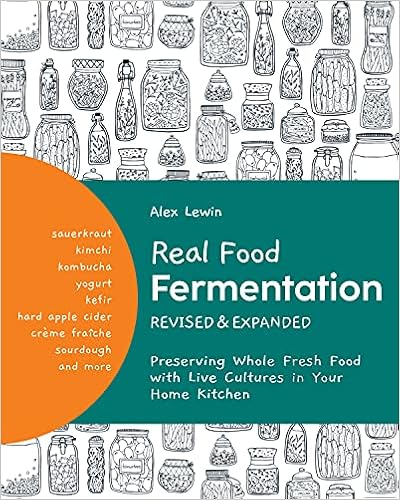
    My book, Real Food Fermentation, has more information about fermented foods. Click here for information about how to get the book.

    Basic Sauerkraut

    Ingredients and Equipment

    • cabbage (round, green or red)
    • salt (1/3 ounce or 2 tsp. per pound of cabbage; or 20g per kg of cabbage)
    • large, sharp chef's knife
    • large cutting board
    • large mixing bowl
    • mason jars, preferably wide-mouthed (a bit more than 16 oz. capacity per pound of cabbage)
    • a digital kitchen scale (available from your favorite brick-and-mortar store, or online)
    • (optional) a thin, narrow-mouthed mason jar to stuff with

    Instructions

    • chop cabbage, finely or coarsely
    • put cabbage and salt in mixing bowl
    • squeeze cabbage and salt vigorously with hands until liquid runs freely (this may take a few minutes)
    • put cabbage and liquid in mason jars, leaving an inch or two of "headroom", and close lids
    • leave to sit, not in sunlight, but somewhere you won't forget about it (kitchen counter?)
    • "burp" the jars every day for the first few days (if you don't do this, they may spill over and/or break the top!)
    • it's ready after 4 days or 4 months or somewhere in between, depending on how you like it

    Eat it

    • on its own
    • on a sandwich
    • as a side dish with grilled meat
    • juice it!

    Mixed/Fancy Kraut

    Follow recipe for Basic Sauerkraut, but use a mixture of vegetables instead of just cabbage, slice or cut into shapes and sizes as you like, and/or add herbs and/or spices to taste. Caraway seeds are a classic seasoning; 1 tsp per pound of cabbage is a ballpark amount, although different caraway seeds have different potencies. Things like garlic, ginger, turmeric, horseradish, burdock, etc. can provide nice flavor and health benefits.

    Beet Kvass

    Ingredients and Equipment

      • a handful of beets (red or golden, number needed may vary with size)
      • 1 Tbsp salt
      • large, sharp chef's knife
      • large cutting board
      • half-gallon mason jar
      • (optional) vegetable peeler 

      Instructions

      • fill jar halfway with water
      • add salt
      • put lid on jar and shake until salt is dissolved
      • if the beets are not organic, peel them
      • cut beets into 1/2-inch cubes
      • put beets in mason jar, to fill about 1/4 or 1/3 of jar
      • fill jar nearly to top with water, leaving an inch or two, and close lid
      • beet greens, if there were any, can be fermented as "Mixed/Fancy Kraut" recipe above
      • wait a 4 days to 4 weeks, tasting the liquid periodically
      • once you like it, strain out the beets and store them separately
      • the liquid is "beet kvass"
      • the fermented beets may be slice and used in a salad, or juiced, or whatever

      Drink it

      Preserved Lemon (Citrus)

      Ingredients and Equipment

      • lemons, Meyer lemons, limes, or citrus of your choice, ideally from a garden rather than from a shop
      • salt (approximately 10% of weight of citrus)
      • knife & cutting board
      • mixing bowl
      • big mason jars
      • (optional) "pickling spice" mix from store (without preservatives; read the ingredients)

      Instructions

      • cut citrus into approximately 1/2 inch (1 cm) squares
      • squeeze citrus over mixing bowl; add the peel to the bowl as well
      • add salt and optional spices to bowl; mix
      • pack the mixture tightly into mason jars, leaving an inch or two of headroom, and close lids
      • let the lemons sit for months or years

      Eat it

      • anywhere you might use fresh lemon
      • in your potato salad (or tuna salad or chicken salad)
      • cook it with fish or roast chicken
      • add a shot of sweetener for a fermented lemonade

      More Things to Read


      Friday, January 10, 2014

      I'm Teaching A Fermentation Class At Stanford

      I'm teaching a fermentation class at Stanford, in partnership with Dr. Tia Rich and Dr. Angela Marcobal. It will be on four consecutive Fridays—Feb 28, Mar 7, Mar 14, and Mar 21—from 12:30-1:30pm.

      Details are here (at the bottom of page 7). To register, click here, search for "ferment", and proceed. (If someone finds a reasonable way to link directly to the class page, please post a comment.) Enrollment is limited to 25, and as I write this, 14 spots have been taken already.

      Thursday, January 17, 2013

      Make Easy Nourishing Soup From Leftovers

      Recently, I've been re-reading Sally Fallon and Mary Enig's very important book, Nourishing Traditions.

      I've also been thinking about food waste, and how each of us can avoid wasting food.

      Tuesday, September 4, 2012

      Real Food Fermentation Comes To You

      I have upcoming events
      • on Sept 15 in Providence, RI;
      • on Sept 18 in Boston, MA;
      • on Sept 20 in West Concord, MA;
      • on Sept 30 in Baltimore, MD;
      • and on Oct 13 in Santa Monica, CA.
      Come see me, get a book, and get it signed! Full details are on my events page, which will be updated as more information becomes available and more events are scheduled.

      UPDATE (9/14/2012): There is a new event in Boston on Sept 18. The Cambridge event on Sept 20 has been cancelled. The list above has been updated to reflect these changes. Full info is available here.

      Thursday, June 9, 2011

      Sauerkraut Michelada

      A michelada is a Mexican drink made with beer, ice, salt, and something sour—depending where you are, it might be some combination of lime juice, tomato juice, clam juice, hot sauce, Worcestershire sauce, or the like. It's a great drink for hot weather, like we're having here in Boston (98 and humid tomorrow!).

      But here's the thing—I don't like tomato juice, I didn't have any clam juice, and I wanted something more than just preserved lime.

      What to do?

      I scanned the refrigerator, and it came to me: sauerkraut michelada!


      Actually, michelada with mixed fermented vegetables: red cabbage, turnips, parsnips, beets. I topped it off by rimming the glass with sal de gusano (ingredients: salt, chile pepper, and roasted agave worm).

      So in addition to my refreshing beer, I got some fermented vegetable probiotics (which probably survive quite a while in the mere few percent alcohol of an iced-down beer), and some minerals from the worm salt.

      Delicious!

      (And it got me thinking...kimchi michelada?)

      Monday, October 18, 2010

      Fermenting Vegetables

      Last weekend, I did a fermentation demo as part of the Urban Homesteaders' League Market Stand at the Union Square farmers' market in Somervile, MA. (Photos.) The Market Stand is a great project that brings together skill-sharing presenters with farmers' market attendees. Among other things, it features a reference library (that UHL mastermind Lisa Gross schleps back and forth to the stand), a swap table (where you can leave things and take them—I left some fermented vegetables!), and a handout containing notes from each of the presenters.

      I would encourage anyone who's around Cambridge or Somerville either of the next two weekends to go check it out. And I would encourage folks in other cities to do something similar to the Market Stand! It gets folks thinking about food (and other topics) a little more deeply. They come home from the market not only with a bag of turnips, but with new insights into those turnips.

      Below are the notes that I distributed to go with my presentation.

      FERMENTING VEGETABLES

      Today, most of the food we consume has been preserved in one way or another. We rely heavily on refrigeration, freezing, and sterilization/canning. These are all modern techniques. Refrigerating and freezing were impractical during harvest season until recently; canning dates back only to the early 1800s.

      Vegetable fermenting is an older preserving technique. There is evidence of fermented kimchi, a close relative of sauerkraut, from as long ago as 600-1000 BCE.

      Fermentation relies on the action of microbes to change the chemical composition of our food. Lactofermentation of vegetables, in particular, takes place when Lactobacillus and other types of human-friendly bacteria convert naturally-occuring plant sugars into lactic acid. As the acidity rises, the medium become less and less hospitable to other microbes—most notably the human-unfriendly ones.

      Fermentation has advantages over other preservation methods.

      When you compare it to canning, you find that fermentation creates an ecosystem in a state of stable equilibrium. You don't have to start your fermentation from a completely sterile state; in fact, you can't! Fermentation also preserves, even enhances, enzymes and vitamins that are diminished or destroyed by the heat of canning.

      Fermenting vegetables does not require any electricity. It requires only some salt, to give the Lactobacillus a head start over the human-unfriendly bacteria, and an ambient temperature between roughly 50 and 80 degrees Fahrenheit, which can be found by digging down a few feet into the ground, even at the height of summer or in the depths of winter.

      Many raw plants contain compounds that our bodies can't process very well. Fermentation helps us here by breaking down these compounds. Fermented cabbage and fermented soybeans are much more digestible than their unfermented counterparts, for instance.

      Finally, fermenting vegetables is fun, and provides a great way for you to get back in touch with your food—literally!

      HOW-TO

      Choose freshly-picked vegetables. Prime candidates include cabbage, turnips, rutabagas, and radishes. In my experience, these work excellently (presumably because they tend to host healthy colonies of Lactobacillus). You can ferment just about any other vegetables, too, but I would advise combining them with one of the vegetables I mention above, or with a starter. The easiest starter to use is a portion of fermented vegetables or juice from a previous batch.

      I like to combine turnips, beets, and parsnips. Cabbage, onions, and carrots. Or just turnips on their own. Any of these will work.

      Wash and/or peel the vegetables. Cut off any parts you're not using.

      VARIATION 1

      Weigh the vegetables. For every pound of vegetables, allocate two teaspoons of salt. Alternatively, for every kilogram, use 20 grams of salt. This works out to roughly 2% salt by weight. Use sea salt or Kosher salt that is free of additives.

      Slice or shred the vegetables finely, with a knife or a box grater.

      Mix the vegetables together with salt. Add herbs and spices as desired. Pack the mixture tightly into Ball jars or other jars with tightly-closing lids, leaving at least an inch of space at the top. Really push down on the mixture until liquid starts to rise over the top. Close the lid. Leave it at cool room temperature. (Root cellar, cool pantry, or bury it!)

      Every day or two, open the lid, taste it with a clean fork, push down until liquid rises again, and replace the lid.

      When you like the way it tastes, start eating it! The colder you store it, the more slowly it will sour. When it becomes very sour, it can still be used in soups and stews.

      VARIATION 2

      Put the vegetables, whole or in pieces, with herbs and spices as desired, into large Ball jars with tightly-closing lids. Using water that is free of chlorine, make a 6% brine by dissolving 60 grams of salt per liter of water, or approximately 4 tablespoons per quart. (The brine should be at room temperature.) Pour the brine into the jars to cover the vegetables, leaving a little space at the top. Close the lid tightly.

      Wait a week, or much longer, before opening the lid.

      Eat the vegetables!

      (For variation 2 in particular, apparatus can be helpful, to keep the vegetables under the liquid and to keep the "bad" microbes at bay. I've had excellent experiences with Pickl-It, for instance.) [UPDATE: see here for some more thoughts about airlock contraptions.]

      BIO

      Alex Lewin is a fermenter, health coach, software engineer, real food activist, and urban biker. He authors a blog called "Feed Me Like You Mean It". He thinks that Ball jars are the ultimate glassware. His heroes include Sandor Katz, Vandana Shiva, Anthony Bourdain, and Kurt Vonnegut.

      RESOURCES

      Real Food Fermentation, by Alex Lewin
      http://tinyurl.com/vegferment
      Wild Fermentation, by Sandor Ellix Katz


      Saturday, December 5, 2009

      I Am Teaching A Food Preserving Class, Feb 9 & Feb 16 2010

      Coming up:
      Click here to register
        Here's the course description:
        Since the start of recorded history, humans have been preserving food. Refrigeration and freezing have become popular recently, but many interesting alternatives exist.

        During class 1, we will explore some or all of the following topics: fermentation of vegetables and fruits (including sauerkraut, pickled root vegetables, kimchi, preserved lemons, etc.); cucumber pickles, relishes, and chutneys; brined meat (corned beef); preserved dairy (yogurt, ricotta cheese); kombucha; salting and drying (dried fruit, dried vegetables, dried meats, potato chips); etc.. Along the way, we will discuss food history; food safety; knife skills; and seasoning.

        During class 2, one week later, we will prepare dishes, using some of the preserved foods from class one as ingredients. Menu items may include corned beef reuben sandwiches (with sauerkraut and/or kimchi); traditional Alsatian choucroute; a variety of canapés using chutneys and kimchi; lactofermented cole slaw; broiled chicken with preserved lemons and herbs; baked ricotta; kombucha-poached scallops; etc.
        Click here to register


          If you would like to hire me to do a sauerkraut or fermentation event for you, please email or call me (four one five, five nine six, seven six one three). I can tailor-make an event to fit your group or occasion.

          These are some of my past public events:

          Tuesday, December 1, 2009

          Slow Food BU Sauerkraut Workshop Recap

          Elizabeth Jarrard of Slow Food BU posted this fun, informative, and impressively thorough recap of the sauerkraut workshop I held at BU two weeks ago:

          http://dontwhitesugarcoatit.blogspot.com/2009/11/krautin.html

          Awesome photos by Rachel Offerdahl, including my favorite, the "money shot":


          Monday, November 9, 2009

          I'm Doing Two Pickling Workshops Next Week

          1. Tuesday, November 17, 6:30-7:30PM, for Slow Food BU. Very limited capacity.

            Email slowfood@bu.edu to register and to get full details.

          2. Thursday, November 19, 5:30-7:00PM, at Project Hope, 550 Dudley St., Roxbury. $7 per person to cover materials. You will make your own sauerkraut and other pickled vegetables to take home. Bring your own knife, cutting board, and mixing bowl if possible.

            This workshop is being produced by Pueblo Community Land Trust. Pueblo is an urban land trust dedicated to, among other things, initiating intentional neighborhood programs with its neighbors in the Roxbury, Jamaica Plain, and Dorcester neighborhoods of Boston. This is one of the first programs organized by Pueblo. Project Hope is generously donating the space.

            Email hope@lactoferment.com to reserve a spot. Advance reservations are limited; many of the spaces are reserved for walk-ins.

          Friday, October 23, 2009

          T.W. Food World of Sausage

          Having recently been involved in a flurry of sausage-related activities (making, sourcing, and of course eating), I was excited that T.W. Food, my favorite "special" Boston-area restaurant, was hosting a one-night World of Sausage dinner.


          My mom and I attended for an early dinner. The menu gave us only two decisions to make: meat or non-meat, and drinks pairing or no drinks pairing. We both got the meat menu, and we split a drinks pairing.

          The (somewhat) short version of the story:
          • Eight different sausages made their way across the table and into our stomachs (counting the dessert ice cream "sausage").
          • The amuse-bouche, perhaps not surprisingly, was sausage (Italian garlic sausage), together with some nice lactofermented vegetables (leek, yellow bean, green pepper, kohlrabi).
          • All of the food was great. My mom's favorite was a frothy borscht that surrounded a Polish smoked bacon sausage (think kielbasa). She was ready to order a whole bowl of the borscht. The dish that stayed with me the most was the choucroute royale. The champagne-cured sauerkraut was pale pink; chopped fine; had just the right combination of sourness, sweetness and saltiness; and sat on a discreet layer of somewhat-mashed potatoes. Three different sausages accompanied it beautifully. To be fair, the scallop and lobster sausage sure was good…and so was the bierwurst with perfect spätzle…and…
          • The drinks pairings complemented the food excellently. Bierwurst and spätzle got a pilsner beer, Polish smoked sausage with red beet-caraway soup got a California Pinot Noir, scallop and lobster sausage in squash sauce got a Willamette Valley Chardonnay, choucroute got an Alsatian Pinot Blanc, the cheese course of Repenaer aged gouda and Bavaria Blu got a dark Belgian ale, and the ice cream "sausage" got a delicious Petite Syrah dessert wine. Note the complete and delightful disregard for typical wine and beer sequencing.
          Reasons I love T.W. Food (in no particular order):
          • The food is imaginative, painstakingly and conscientiously prepared, and consistently top-of-the-line. And the menu changes all the time, and you can always sneak a peek at it on the web.
          • The servings and wine pairings are just right—neither meager nor excessive. (Keep in mind that I like to eat and drink, so in the grand scheme of things, the servings are probably quite generous.)
          • It is fantastic to be able to have an appropriate, excellent, and different wine (or beer) with every course. Sometimes the pairings are surprising, other times (like tonight) they are more or less straight-ahead, but always they are thoughtful and good.
          • T.W. Food is not inexpensive, but their prix fixe meals are a stand-out value among Boston restaurants.
          • All of the prix fixe menus include a meat-free option. And the meat-free offerings are every bit as good as the meaty ones. When I've dined with friends who have chosen the meat-free option, I have often found myself stealing things off their plates. So there is truly something for everyone (almost…maybe not for vegans).
          • The restaurant is classy but unpretentious. The service is great but not fussy. The place has a good feeling to it.
           Prost!

          Wednesday, October 21, 2009

          I Am Quoted in NOW Toronto Magazine

          NOW is a full-color, magazine-format Toronto weekly with a circulation of 395,000 and an impressive website. The closest thing that Boston has is the Phoenix, although it is black-and-white tabloid format, and its circulation is smaller (253,000).

          Elizabeth Bromstein wrote an article about fermented foods in the alt.health column of NOW entitled Potion in a Pickle.


          She quotes me in the article.

          Click here to read it. (Scroll to the bottom to see my quote.)

          http://www.nowtoronto.com/lifestyle/althealth.cfm?content=17128

          Thursday, October 1, 2009

          Sauerkraut Demo, This Saturday 12:30PM-1PM, Rain Or Shine

          Reminder:

          I'll be doing a demonstration of how to make sauerkraut this Saturday from 12:30PM-1PM on Dewey Square, diagonally across from South Station in Boston. Admission is free! Come check it out!

          Rain or shine!

          I'll be using cabbage from Keown Farms, one of the vendors from the Boston Public Market Sponsored by Rodale at Dewey Square.

          My demo will be part of a big fair running from 12PM-6PM on the Rose Kennedy Greenway. For more details, click here.

          Friday, September 25, 2009

          Reflections On My First Pickling and Preserving Class

          Going into my first cooking class as an instructor, I was nervous. The curriculum and some of the recipes were untested. I didn't know exactly how many people would be in the class, where they would be coming from, or how much experience they would have. I also didn't know whether or not I would have any assistants, or even what I would do if I had them!

          As it turned out, there were 13 enrolled students; 1 school intern; 1 photographer; and 5 (!) assistants. Everyone in the class was a pleasure to work with, and had great kitchen skills. And the assistants were able and tireless; they increased everyone's enjoyment of the class (mine not least of all!).

          We started with a discussion of food preserving. I talked about why it is important for us to be able to preserve food. Then I discussed food safety, and the various factors we can control to prevent food spoilage. This led to a discussion of some of the different methods of food preservation, including freezing, refrigerating, lactofermentation, vinegaring, canning, and drying, with a separate discussion of preserving dairy. Lactofermentation is my favorite preserving method, because it is easy, healthy, safe, and tasty. For more discussion of lactofermentation, check my previous blog post here.

          I shared a few thoughts about kitchen organization, including one of my favorite techniques, which is labeling and dating everything that goes into the fridge! My refrigerator houses many mason jars containing homemade things. If I didn't label and date them, I would lose control of my fridge pretty quickly. I date things I buy, too, so that I know when I opened them, and when it might be time to get rid of them.

          After that, I did a brief knife technique demo, illustrating the benefits of having a large knife, especially when working with large vegetables like cabbage. I also demonstrated methods for cutting up green peppers, onions, and apples.

          After the discussion and demonstration, we moved into the kitchen to work with food. Everyone made some sauerkraut (of course!), then various people made yogurt, kimchi, pickles, other lactofermented vegetables (including parsnips), lactofermented lemons and plums, kombucha, and corned beef; we also made (non-fermented) applesauce and canned it, using the method from the Ball Blue Book. At the end of class, everyone took home their sauerkraut and other lactoferments, to babysit them during the week.

          In the second class, a week later, everyone brought back their various krauts, and we admired their diversity and rainbow colors. After a brief strategy session, we divided into teams, and made dishes using all of our preserved foods from the week before. These dishes included yogurt-cucumber salad; lactofermented coleslaw; mayonnaise and Russian dressing; different kinds of canapés and sandwiches involving raw and cooked corned beef, sauerkraut, kimchi, coleslaw, pickles, etc.; kombucha and salty-sweet preserved fruit and drinks; broiled chicken with preserved lemon; choucroute garnie, "the king of sauerkraut dishes"; and a delicious baked ricotta dish with pine nuts, honey, and dried fruit.

          I will definitely be teaching the class again. Watch this space for dates and times. And if you have suggestions, requests, comments, or questions regarding the class, please add them in the "comments" section of this blog post, below.

          Tuesday, September 22, 2009

          I'm Doing Free Sauerkraut Demos, Oct 3, 12:30PM-1:00PM


          What: Sauerkraut-making demo!
          When: October 3, at 12:30PM, 12:45PM, and 1:00PM
          Where: Dewey Square, diagonally across the street from South Station, in Boston, MA.

          On the afternoon of October 3, I will be doing a sauerkraut-making demo at Dewey Square as part of the Try Something New festival on the Rose Kennedy Greenway.

          Dewey Square is the site of the biweekly farmer's market (Tuesdays and Thursdays) run by the Boston Public Market Assocation, on whose board I serve.

          The Greenway is a mile-long park stretching through downtown Boston, encompassing gardens, plazas, and promenades. It is located where the elevated portion of I-93 used to be, before the Big Dig. It is lovely.

          Come out to support me, enjoy the festival, get to know the Greenway, and learn how to make sauerkraut!

          Friday, September 11, 2009

          How To Make Sauerkraut (video)

          An instructional video of me making sauerkraut (expertly filmed and edited by how2heroes!)

          (Click here if the video does not appear below.)

          Monday, September 7, 2009

          Sauerkraut Is A Powerful Natural Aphrodisiac

          For reason number 538 to eat sauerkraut, click here.

          Sunday, August 16, 2009

          Canvolution in Somerville, August 30

          My friend Linsey is organizing a food canning workshop in Somerville, MA, on August 30, in canjunction with Cans Across America. As part of this event, I will be doing a short lactofermentation talk and demo. (That's sauerkraut and pickles, folks!) Full details and sign-up info here.
          Plus, it's never too early to sign up for my full-on, two-part food preserving class through the Cambridge School of Culinary Arts.

          Friday, June 26, 2009

          I Am Teaching Pickling And Preserving

          Briefly:

          Two class series. First class, we pickle and preserve things in interesting and healthful ways. Second class, we use our delicious preserved stuff as ingredients in all kinds of dishes, plain and fancy.

          Click here to sign up.

          A 2-class series at the Cambridge School of Culinary Arts in Cambridge, MA.

          Thu Sep 17 2009, 6:30PM-9:30PM
          Thu Sep 24 2009, 6:30PM-9:30PM
          $150

          More details:

          I will definitely talk about the history of food preserving, preserving as it relates to nutrition, food safety in the context of preserving (aka "how not to poison yourself"), herbs and spices and seasoning, etc. Also knife skills demos, because knife skills are crucial to all kinds of food work, and we will have lots of cabbage to practice on.

          I'm thinking that in the first class, everyone will make sauerkraut, and everyone will make applesauce and can it (as an example of canning). Beyond that, we'll divide and conquer to dry some fruits and vegetables and perhaps meats; make some kimchi, preserved lemons, and other vegetable ferments and pickles of various styles; do some dairy ferments including yogurt, kefir, and perhaps some cheese; and make corned beef (using Meat Of Known Origin, of course).

          Then in the second class, after all the ferments have fermented for a week, we'll assemble some serious dishes around our stuff!

          If you have questions about the class, feel free to ask them in the "comments" section below, or contact me via email.

          Please sign up as soon as you know you want to take the class—the school needs to have a headcount, and if they don't get enough registrants for the class, they might cancel it!