Sandor Ellix Katz hosted a fermentation workshop on Friday, 8 May 2009, as part of the Boston University
Future of Food conference. Here are my notes from that workshop, rearranged a bit, with some interpolation.
Sandor is the author of
Wild Fermentation and
The Revolution Will Not Be Microwaved, and is a self-declared “fermentation revivalist”.
The Revolution Will Not Be Microwaved has influenced my own thinking about food and food systems more profoundly than anything else I’ve read or seen; each page is better and more fascinating than the last, and the book is a masterful blending of intimacy and rigor. Many of the concepts in the book landed so well and deeply in my brain that I can no longer remember how I looked at things before I read the book.
In the workshop, Sandor described
fermentation, for our purposes, as the transformative action of microorganisms. He points out that fermentation is very easy to achieve, and we are all familiar with it: it is the path of least resistance for a piece of cabbage left out on the counter, for instance.
So if your goal is to ferment a cabbage into a puddle of slime, you don’t need to do anything in particular. If, on the other hand, you seek something edible, you must employ some art. This art is the deliberate manipulation of environmental conditions to favor desired microorganisms—conscious fermentation, if you will.
He made a further distinction between
cultured fermentation, which involves the intentional introduction of microbes for the purposes of fermentation; and
wild fermentation, which relies on whatever microbes may already be present on your vegetables and in your air, and sometimes a pinch of serendipity. Adding some of your old yogurt to milk in order to make a new batch of yogurt, is an example of cultured fermentation. Chopping up cabbage, salting it, and leaving it to its own devices is an example of wild fermentation.
Historically, the need to preserve food has led people to ferment food, including vegetables (sauerkraut and friends), dairy products (yogurt-type things, cheese, sour cream, some kinds of butter), grain products (bread, porridges, and some alcoholic brews), and meats (sausages, hams).
Since the 19th century, canning, refrigeration, and freezing have emerged as alternative methods of food preservation. They are convenient in some respects, but nutritionally speaking, they are a step backwards from fermentation.
Refrigeration and freezing do not increase food nutritiousness, and can degrade it slightly; canning degrades it significantly. Canning uses heat to kill any bacteria present in the food, and while this gives canned food a potentially very long shelf life, it also reduces heat-sensitive vitamins like C and some of the Bs, along with enzymes. In some sense, canning is the
opposite of fermentation, since canning involves eliminating bacteria entirely, while fermentation involves guiding and benefiting from the work of the bacteria.
Fermentation can enhance the nutritional value of food, often in ways that we are only now beginning to understand. Among the potentially healthful compounds created via fermentation are B-vitamins; isothiocyanates (possible carcinogenesis inhibitors); dipicolinic acid (which may help in the elimination of heavy metals from the body); and nattokinase (which may counteract cardiovascular disease and Alzheimer’s). The fermentation bacteria themselves aid digestion and the immune system.
Beyond that, fermentation can be used to make water drinkable, by shifting its bacterial balance and introducing small amounts of alcohol. Similarly, fermentation allows us to eat foods that would otherwise be problematic; for instance, eating a big pot of soybeans leads to serious indigestion, but soy is easy to digest in its fermented forms like miso, soy sauce, natto, tempeh, and fermented tofu. Furthermore, fermentation can break proteins into their constituent amino acids, increasing their usefulness to our bodies. Fermentation can transmogrify lactose, which many people cannot digest. And fermentation can make minerals more bioavailable.
Sandor talked about raw (unpasteurized) milk. An interesting note is that pasteurization was originally developed for the commercial wine-making industry. The old way of making wine was to juice the grapes and hope for the best; the new way was to juice the grapes, sterilize the juice, and then add specific yeasts, in order to have control over the direction of its fermentation.
Sandor characterized milk pasteurization as “an excellent salvage protocol for milk from animals raised under substandard conditions”—animals feeding on inappropriate diets, standing knee-deep in their own excrement, and/or forced to overproduce milk by means of artificial hormones. That describes most of the cows in the US.
Wendell Berry, noted poet-farmer, spoke of the correlations between the modernization of agriculture and the deterioration of society.
Sandor observed that along with the War on Terror and the War on Drugs, we are waging another war that is seldom explicitly named—the
War on Bacteria. The battlefields range from our (antibacterial) handsoap to our (antibacterial) socks to our cows (injected with antibiotics) to our (pasteurized) milk. It is a war that we can’t possibly win; and if we did win it, we would be in trouble. In the meantime, we are being hoisted by our own petard. We are selectively breeding harmful new bacteria, harming our own bodies, and destroying our planet.
There are a surprising number of fermented foods we sometimes forget are fermented. Sandor invited us to imagine a stroll through Zabar’s, the famous gourmet deli in New York City. Olives, (most) cheeses, sausages, corned beef, pastrami, ham, pickles, sauerkraut, and so on are fermented. We don’t usually think of bread as being a fermented food, but without the activity of yeast, bread would not be bread. Coffee, (most) tea, chocolate, and vanilla depend on fermentation. Most of the condiments we know and love, from ketchup to vinegar to Worcestershire sauce to fish sauce, also rely on fermentation in one way or another.
Fermentation has in fact always accompanied culture and agriculture. Some of the earliest human writings have mentioned fermentation—hence it is likely that fermentation dates back to prehistory. And more recently, fermented foods have played key roles in specific cultures.
Fish sauce has been used in Asia for millennia, and was used in ancient Rome, where it was so important that it was used as a form of currency (
garum).
The original kefir grains, legend has it, were brought from Allah to humankind by Mohamed.
Other culture-specific ferments can provide a test to distinguish insiders from outsiders—or, at the very least, are acquired tastes. Natto, for instance, is a trademark Japanese soy ferment that is stringy, slimy, smelly, and notoriously unappealing to most non-Japanese. Iceland has hákarl, a fermented shark preparation that I will charitably describe as “pungent”. More than one group of people has a beverage made by chewing a plant, spitting the chewed plant and saliva into a large vessel, and leaving it all to ferment.
In his volume
The Raw and the Cooked, the French anthropologist Claude Lévi-Strauss distinguishes among raw food, rotten food, and “cooked” food (including fermented food), and characterizes cooked food as the triumph of the human over the rotten.
Enough theory. Time to ferment!
After noting that English does not have its own word for “fermented vegetables” and settling on the borrowed German word
sauerkraut, Sandor demonstrated his method:
- Chop up your vegetables. Use cabbage, carrots, onion, whatever. You can use anything you would consider eating raw (so no potatoes). You can use herbs and spices if you like.
- Add salt. In his book, he suggests 3 tablespoons of salt for 5 pounds of cabbage. He emphasizes that this is not a prescription, just a possibility. According to Sandor, commercial sauerkraut operations use between 1.5% and 2.5% salt, by weight. The salts in my cabinet right now range from 10g/T (for kosher salt) to 18g/T (for coarse sea salt). Doing the math, 30-54 grams of salt for 2300 grams of cabbage puts us in the 1.5%-2.5% range.
The salt pulls the water out of the vegetables, via osmosis; narrows the variety of bacteria that can grow, favoring lactic acid bacteria; slows down the action of all the bacteria, including the lactic acid bacteria; and makes the vegetables crunchier by hardening the pectins they contain.
- Mix it all, and squeeze it with your hands. The squeezing accomplishes two things: it helps the salt pull the water out of the cells in the vegetables, and it softens up the vegetable fibers a bit.
- Pack it tightly into pint-jars. Use your hand or some other instrument to push it down so that the liquid rises above the top of the vegetables, to forestall surface mold (by “drowning” it).
- Leave the jars out at room temperature for as long or as short a time as you like. Every day or so, open the jars and push down on your kraut so that the liquid rises (again, to prevent mold).
If mold grows on it, skim it off.
Taste your sauerkraut regularly, and eat it whenever you think it’s ready!
Sauerkraut is a good choice for a first fermentation project—it is easy, it is satisfying, it is delicious, it has a high success rate, and it doesn’t require any special equipment.
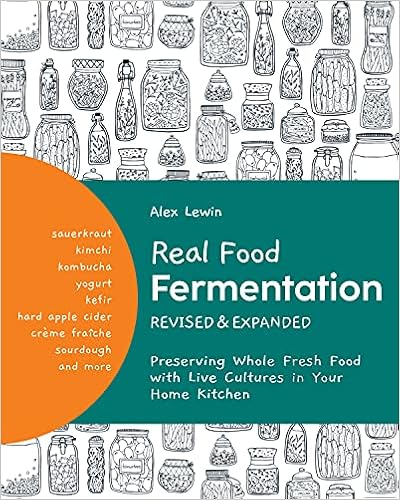
Sandor was signing copies of
Wild Fermentation at the workshop. If you are interested in fermenting food, I definitely recommend this book—even if you can’t get it signed!
You can also visit his website at
http://www.wildfermentation.com/.
As a final note, Sandor encouraged us to consider that fermentation is a great activity for farmers and food artisans, allowing them to take inexpensive, perishable raw materials (cabbage, milk) and transform them into more expensive, more durable products, while at the same time building the local economy and increasing local food security and self-reliance.