Showing posts with label workshop. Show all posts

Monday, April 20, 2015

Basic Fermenting Recipes

I'm making this post for attendees at the hands-on the workshop I did at Pollinate Farm & Garden in Oakland, California on April 19.

But anyone else is welcome to read the post too. :-)

Please post in the "comments" section below if you have questions, or if you'd like to discuss other ways to eat these fermented foods (I've offered a couple, but I've only scratched the surface).

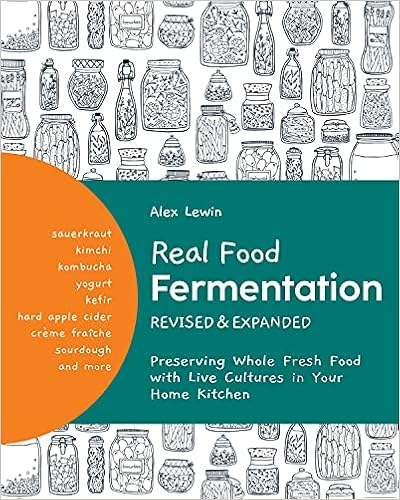
My book, Real Food Fermentation, has more information about fermented foods. Click here for information about how to get the book.

Basic Sauerkraut

Ingredients and Equipment

  • cabbage (round, green or red)
  • salt (1/3 ounce or 2 tsp. per pound of cabbage; or 20g per kg of cabbage)
  • large, sharp chef's knife
  • large cutting board
  • large mixing bowl
  • mason jars, preferably wide-mouthed (a bit more than 16 oz. capacity per pound of cabbage)
  • a digital kitchen scale (available from your favorite brick-and-mortar store, or online)
  • (optional) a thin, narrow-mouthed mason jar to stuff with

Instructions

  • chop cabbage, finely or coarsely
  • put cabbage and salt in mixing bowl
  • squeeze cabbage and salt vigorously with hands until liquid runs freely (this may take a few minutes)
  • put cabbage and liquid in mason jars, leaving an inch or two of "headroom", and close lids
  • leave to sit, not in sunlight, but somewhere you won't forget about it (kitchen counter?)
  • "burp" the jars every day for the first few days (if you don't do this, they may spill over and/or break the top!)
  • it's ready after 4 days or 4 months or somewhere in between, depending on how you like it

Eat it

  • on its own
  • on a sandwich
  • as a side dish with grilled meat
  • juice it!

Mixed/Fancy Kraut

Follow recipe for Basic Sauerkraut, but use a mixture of vegetables instead of just cabbage, slice or cut into shapes and sizes as you like, and/or add herbs and/or spices to taste. Caraway seeds are a classic seasoning; 1 tsp per pound of cabbage is a ballpark amount, although different caraway seeds have different potencies. Things like garlic, ginger, turmeric, horseradish, burdock, etc. can provide nice flavor and health benefits.

Beet Kvass

Ingredients and Equipment

    • a handful of beets (red or golden, number needed may vary with size)
    • 1 Tbsp salt
    • large, sharp chef's knife
    • large cutting board
    • half-gallon mason jar
    • (optional) vegetable peeler 

    Instructions

    • fill jar halfway with water
    • add salt
    • put lid on jar and shake until salt is dissolved
    • if the beets are not organic, peel them
    • cut beets into 1/2-inch cubes
    • put beets in mason jar, to fill about 1/4 or 1/3 of jar
    • fill jar nearly to top with water, leaving an inch or two, and close lid
    • beet greens, if there were any, can be fermented as "Mixed/Fancy Kraut" recipe above
    • wait a 4 days to 4 weeks, tasting the liquid periodically
    • once you like it, strain out the beets and store them separately
    • the liquid is "beet kvass"
    • the fermented beets may be slice and used in a salad, or juiced, or whatever

    Drink it

    Preserved Lemon (Citrus)

    Ingredients and Equipment

    • lemons, Meyer lemons, limes, or citrus of your choice, ideally from a garden rather than from a shop
    • salt (approximately 10% of weight of citrus)
    • knife & cutting board
    • mixing bowl
    • big mason jars
    • (optional) "pickling spice" mix from store (without preservatives; read the ingredients)

    Instructions

    • cut citrus into approximately 1/2 inch (1 cm) squares
    • squeeze citrus over mixing bowl; add the peel to the bowl as well
    • add salt and optional spices to bowl; mix
    • pack the mixture tightly into mason jars, leaving an inch or two of headroom, and close lids
    • let the lemons sit for months or years

    Eat it

    • anywhere you might use fresh lemon
    • in your potato salad (or tuna salad or chicken salad)
    • cook it with fish or roast chicken
    • add a shot of sweetener for a fermented lemonade

    More Things to Read


    Wednesday, April 7, 2010

    Sunday, December 27, 2009

    Save The Dates: Kimchi Workshop, 1/24/2010; Kimchi Festival, 3/21/2010

    SAVE THE DATES for kimchi-related events at the Theodore Parker Unitarian Universalist Church in West Roxbury, MA.

    January 24, 2010, 1PM-3PM: Kimchi Workshop: I will be leading a hands-on workshop covering vegetable fermentation and kimchi. You will leave the workshop with a jar of kimchi that you have made, and you'll be ready to compete in the kimchi festival in March. 15 seats available. $15 fee.

    March 21, 2010, 3PM-7PM: Greater Boston Kimchi Festival: I will be judging and helping organize the Greater Boston Kimchi Festival. Start experimenting with your kimchi now, so that you will be ready to enter it in our kimchi contest! There will be prizes in different categories, including "traditional", "innovative", and "audience picks". We will have a kimchi demo, live entertainment, door prizes, and much more. Proceeds to benefit the Theodore Parker Church. Details TBA.

    For more information, email kimchi-info@lactoferment.com.

    Saturday, December 5, 2009

    I Am Teaching A Food Preserving Class, Feb 9 & Feb 16 2010

    Coming up:
    Click here to register
      Here's the course description:
      Since the start of recorded history, humans have been preserving food. Refrigeration and freezing have become popular recently, but many interesting alternatives exist.

      During class 1, we will explore some or all of the following topics: fermentation of vegetables and fruits (including sauerkraut, pickled root vegetables, kimchi, preserved lemons, etc.); cucumber pickles, relishes, and chutneys; brined meat (corned beef); preserved dairy (yogurt, ricotta cheese); kombucha; salting and drying (dried fruit, dried vegetables, dried meats, potato chips); etc.. Along the way, we will discuss food history; food safety; knife skills; and seasoning.

      During class 2, one week later, we will prepare dishes, using some of the preserved foods from class one as ingredients. Menu items may include corned beef reuben sandwiches (with sauerkraut and/or kimchi); traditional Alsatian choucroute; a variety of canapés using chutneys and kimchi; lactofermented cole slaw; broiled chicken with preserved lemons and herbs; baked ricotta; kombucha-poached scallops; etc.
      Click here to register


        If you would like to hire me to do a sauerkraut or fermentation event for you, please email or call me (four one five, five nine six, seven six one three). I can tailor-make an event to fit your group or occasion.

        These are some of my past public events:

        Tuesday, December 1, 2009

        Slow Food BU Sauerkraut Workshop Recap

        Elizabeth Jarrard of Slow Food BU posted this fun, informative, and impressively thorough recap of the sauerkraut workshop I held at BU two weeks ago:

        http://dontwhitesugarcoatit.blogspot.com/2009/11/krautin.html

        Awesome photos by Rachel Offerdahl, including my favorite, the "money shot":


        Friday, March 6, 2009

        Future of Food conference at Boston University, May 8-9

        On May 8-9, 2009, Boston University is hosting a conference entitled The Future of Food: Transatlantic Perspectives featuring a rousing roster of speakers, film screenings, meals, and opportunities to meet fascinating people, including Sandor Ellix Katz, international fermentation expert and author of my favorite book, The Revolution Will Not Be Microwaved! Cost: probably free Conference URL: http://www.bu.edu/euforyou/IHS/upcoming.html#May9 And if that's not fantastic enough: there are rumors that Sandor Ellix Katz will be giving a fermentation workshop during the day on May 9. Here's from the site:
        We are organizing this conference in response to the growing concerns of local communities in the United States and Europe over matters of health, the environment, and the economy. The conference takes the growing global food crisis as a starting point and asks key stakeholders to imagine a different future. Our working hypothesis is that the current food crisis is systemic in nature and solutions from the past (more market, more regulation, etc.) will not allow the global food system to evolve in a sustainable way. The situation calls for innovations in infrastructure and re-thinking how food is grown, shipped, and distributed locally, regionally, and globally. How can we foster a global food system that safeguards cultural and biodiversity while providing safe and nourishing food for all citizens?